
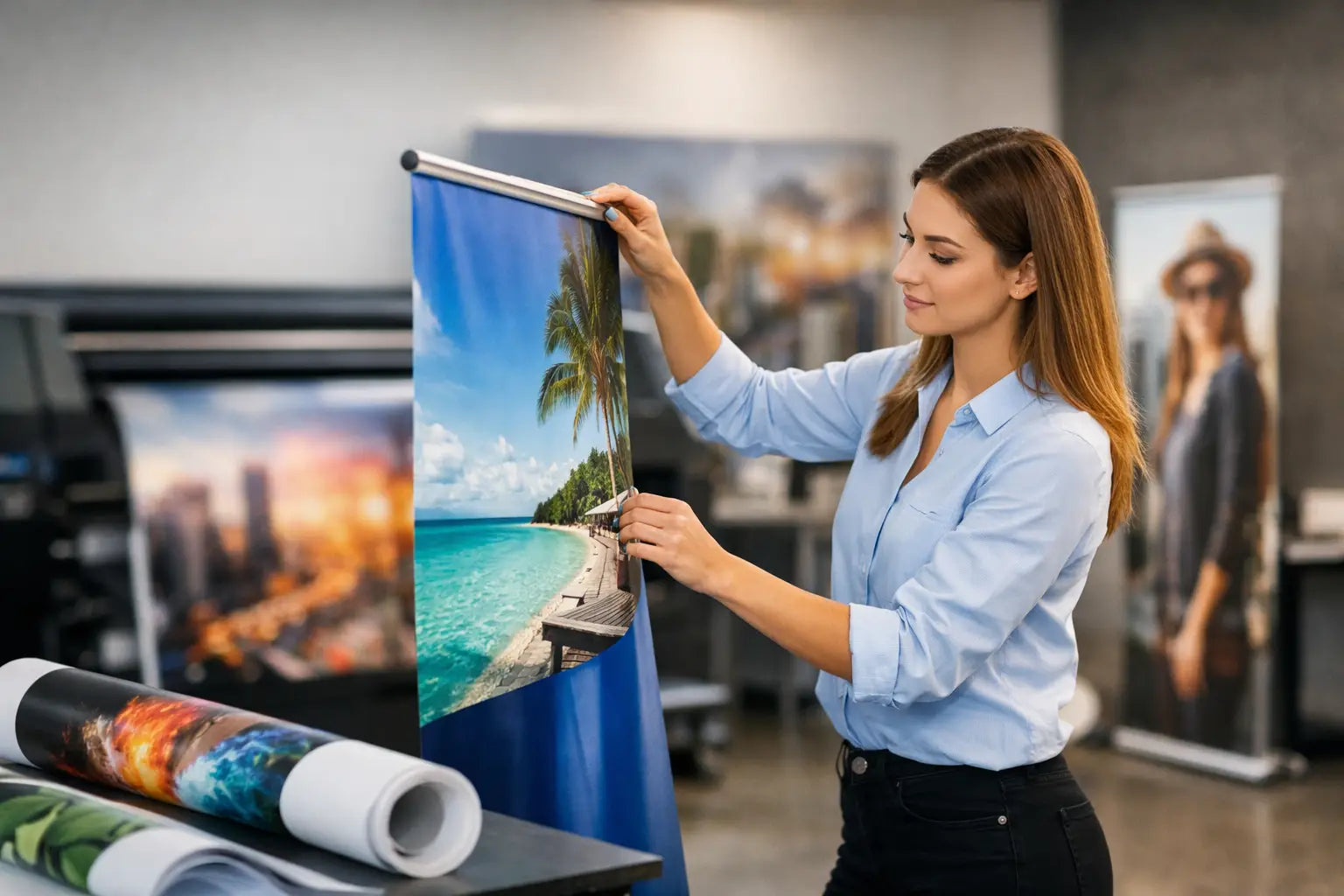
A poster in a shop window has seconds to do its job. A site sign needs to stay clear in poor weather. An exhibition backdrop must look sharp in photographs as well as from across a busy hall. That is where large format printing earns its place: it gives your message the scale, colour and presence that everyday business print cannot provide.
For retailers, tradespeople, venues, schools and event organisers, the right display print can direct customers, promote an offer, reinforce a brand or turn an empty wall into valuable advertising space. The best result is not simply the biggest print available. It is the right combination of size, material, artwork and finishing for where the display will be used.
What large format printing is best used for
Large format print covers a broad range of oversized visual materials, from promotional posters and pull-up banners to window graphics, site signage, exhibition displays and printed boards. It is designed to be seen at a distance, but it also needs to hold up when people step closer.
For a café, that might mean an A1 pavement sign promoting lunch offers. For a construction firm, it could be durable health and safety boards for a live site. An estate agent may need property boards that remain clear through rain and wind, while a wedding customer might choose a welcome sign or seating plan that suits the venue and photographs beautifully.
The purpose should lead the specification. A short-term indoor promotion does not need the same material as a permanent outdoor sign, and an exhibition graphic has different transport and installation needs from a wall-mounted panel. Choosing on price alone can create false economy if the print fades, curls, tears or feels out of place before the campaign has done its job.
Choose the right size for the viewing distance
A common mistake is to design a large display as if it were a flyer. Large format work is normally read in stages: people notice the main message first, then the offer or key detail, then the call to action once they are close enough.
Think about where people will stand. A poster viewed from a few metres away can carry a headline, image and a small amount of supporting information. A banner across a sports pitch or trade counter needs a much simpler message, with bolder type and strong contrast. If customers will pass in a car, a phone number or lengthy web address may be less useful than a memorable brand name and a clear service statement.
Size is also practical. Measure the installation area before ordering and allow for frames, stands, doors, windows and fixing points. A roller banner needs enough floor space to stand safely. A window graphic should not block essential visibility. On a building site, signs must be positioned where staff and visitors can actually see them before they reach a hazard or entrance.
When in doubt, prioritise one clear message. Large print has permission to be bold. It does not need to say everything your business does in a single panel.
Materials matter indoors and outdoors
The material affects appearance, lifespan, handling and cost. Paper posters are an effective choice for indoor campaigns, noticeboards and short-term promotions. They offer excellent colour reproduction and are easy to replace when prices, dates or messages change.
For outdoor use, waterproof synthetic materials, vinyl and rigid boards are often more suitable. They can withstand moisture and regular handling far better than standard paper, but the exact option depends on how long the sign will be displayed and how exposed the location is. A sheltered shopfront and an open roadside position face very different conditions.
Rigid boards give a clean, professional finish for menus, directional signs, property displays and site information. Foamex is a popular all-round choice where a firm panel is needed, while corrugated plastic can suit temporary signage that needs to be light and economical. Vinyl is useful for windows, walls and other smooth surfaces, provided the artwork, surface condition and fitting method have been considered in advance.
For events, portability often matters as much as visual impact. Pull-up banners and lightweight display systems are easy to move between venues, pack away after use and bring out for repeat promotions. If the graphic changes frequently, it may be worth choosing a system that makes future updates straightforward rather than replacing every component.
Artwork that prints clearly at scale
A sharp image on a laptop can look poor when enlarged if the original file is too small. Logos, photographs and graphics need enough resolution for their final print size. Vector logo files are particularly useful because they can scale cleanly without becoming pixelated.
Use high-quality photographs and avoid copying images from social media or screenshots. These are usually made for screens, not large printed displays. If an image is not suitable, a strong colour block, well-set headline and clear logo can often be more effective than a blurry photograph.
Keep text readable with a straightforward font and good contrast. Pale lettering over a busy image may look stylish in a digital mock-up but disappear at a distance. Dark text on a light background, or light text on a solid dark area, is generally easier to read. Leave room around important text too. A headline pressed against the edge can feel cramped, and it risks being lost during trimming or fitting.
Where a graphic runs to the edge of a poster, board or banner, artwork normally needs bleed - a small extra area beyond the finished edge. This gives the printer room to trim accurately without leaving an unwanted white line. Safe margins are equally important, keeping key words, logos and contact details away from edges, eyelets and folds.
If preparing files feels like another job on an already busy list, use a design service rather than hoping for the best at checkout. A quick artwork check before production can prevent costly delays and ensure the final print is fit for purpose.
Finishing turns print into a usable display
Finishing is the part that makes a display ready to install. It may include trimming, mounting, laminating, eyelets, hemming, fitting into a stand or applying adhesive. These details are not an afterthought, particularly when the display will be handled, moved or used outdoors.
Lamination can add protection and make colours feel richer, but it is not essential for every job. For indoor posters used briefly, an unlaminated finish may be perfectly sensible. For frequently handled menus, directional boards or displays that need extra durability, protection can be worthwhile.
Banners need the correct fixing method. Eyelets are useful when tying a banner to railings or a frame, while pole pockets may suit a specific hanging system. Tell your printer how and where the banner will be displayed. The best finishing choice depends on whether it is hanging, mounted, freestanding or fitted to a surface.
Plan for lead time, installation and repeat use
Urgent display print is often needed because an event date, promotion or opening has arrived faster than expected. Fast turnaround can be a genuine help, but it still relies on approved artwork, the correct specification and enough time to check the job properly. Ordering early gives more choice of materials and reduces the pressure around delivery.
It is also worth planning the full journey of the display. Who will receive it? Will it fit in a car? Is someone available to install it? Does the venue require flame-retardant materials or have rules about fixing to walls and windows? These questions are especially relevant for exhibitions, hospitality venues and public events.
For campaigns that return each year, save the approved artwork and note the material, size and finish used. That makes reorders quicker and keeps branding consistent across branches, events or future promotions. It also lets you update only the information that changes, such as dates, prices or contact details.
At Instant Print NI, large displays are handled as production jobs rather than anonymous uploads. That means practical support is available when you need to match a material to a location, check artwork or arrange a quick turnaround.
A well-planned display should keep working after the first glance. Give it a clear purpose, choose a material that suits the setting, and make every word easy to read. The result is print that does more than fill a space - it helps people notice, understand and act.