
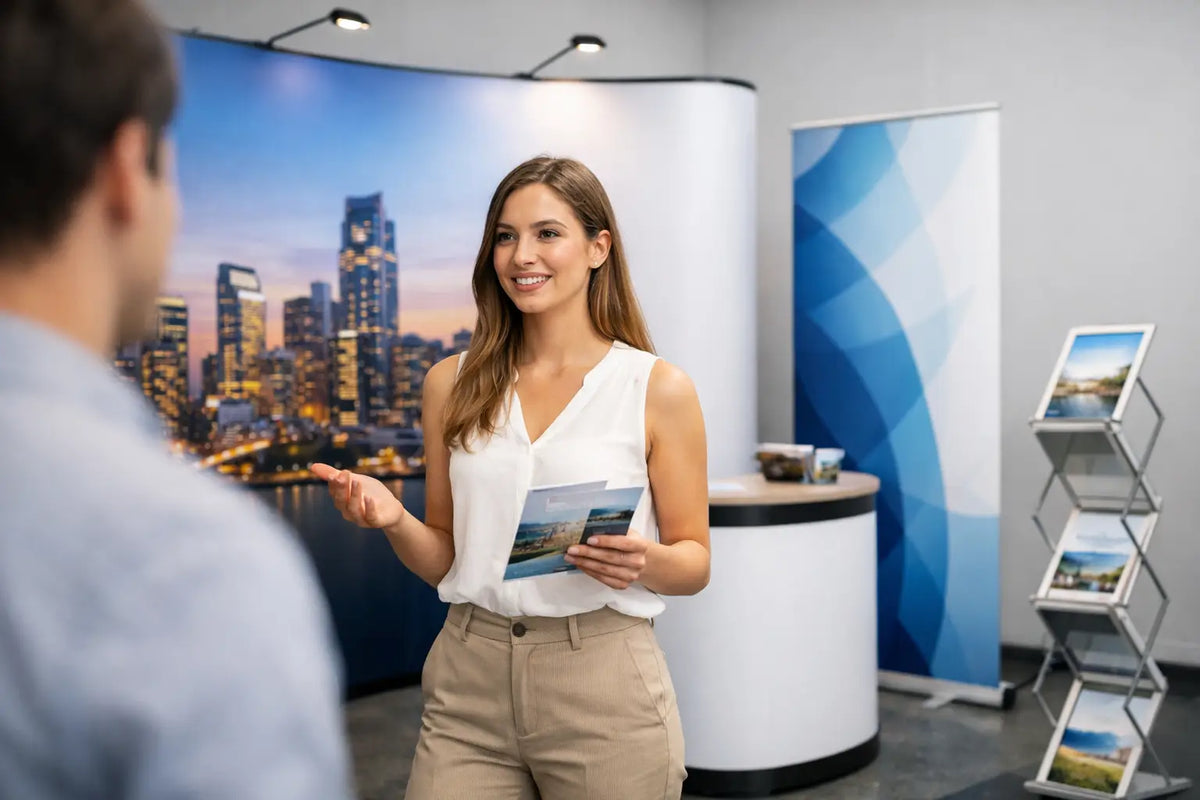
A busy exhibition hall gives you only a few seconds to earn a glance. Pop-up exhibition displays help turn that fleeting moment into a conversation by giving your stand a professional backdrop, clear branding and a visible message from across the room. For businesses, schools, charities and event teams, they are one of the most practical ways to arrive looking prepared without needing a full custom-built stand.
The best display is not necessarily the biggest or the most colourful. It is the one that can be set up quickly, makes sense at a distance and gives visitors a reason to stop. Getting those details right before artwork goes to print saves time, avoids costly last-minute changes and makes every event work harder for your budget.
Why pop-up exhibition displays work so well
Unlike loose posters or a table covered in leaflets, a pop-up display creates an immediate focal point. It gives your team a defined space to meet visitors and makes your business look established, even at a small local fair, careers event or trade exhibition. A well-designed fabric or panel display also photographs well, which matters when event organisers and visitors are sharing images online.
Portability is a major advantage. Most systems are designed to collapse into a carry case, making them manageable for teams travelling between venues. That is particularly useful when you are exhibiting regularly across Northern Ireland, Ireland or the wider UK and need a display that can be stored, transported and used again without fuss.
There is a trade-off, of course. A pop-up stand will not offer the architectural impact of a fully bespoke exhibition build. It also needs a clear graphic plan, rather than trying to carry every product detail you might fit into a brochure. For many small and medium-sized organisations, though, it offers the right balance of presence, speed and value.
Start with the job your display needs to do
Before choosing a size, think about the event itself. A recruitment fair needs a different message from a retail trade show. A community event may call for a welcoming, local feel, while a professional services exhibition may need to establish trust and expertise quickly.
Ask what you want a visitor to do after seeing the stand. You may want them to request a quotation, pick up a brochure, book an appointment, scan a QR code or simply remember your name. One main action is usually enough. If every service, contact method and special offer fights for attention, the display becomes difficult to read.
Also consider where it will sit. A compact pop-up display can be ideal behind a trestle table or in a narrow shell-scheme space. A wider curved or straight backdrop has more visual impact in an open hall, but only if you have the floor space and staff to use it properly. Check your event booking confirmation for the stand dimensions, height limits, access times and electrical arrangements before placing an order.
Designing pop-up exhibition displays for distance
Exhibition artwork is not a flyer enlarged to a bigger size. People often see it from several metres away, while walking, talking or looking for a particular supplier. Your core message needs to be understood quickly.
Put your logo in a prominent position and give it room to breathe. Follow it with a short headline that says what you do or what problem you solve. “Fast local print for business” is more useful at a glance than a paragraph about company history. Supporting text can explain the offer, but it should not compete with the headline.
Use high-resolution images that still look sharp at large scale. A photo taken from a mobile phone may be suitable for social media but can look soft when stretched across a full backdrop. If you are using product photography, choose one or two strong images rather than a crowded collage. Clear, confident visuals tend to stop people more effectively than a busy design full of small boxes.
Colour should work for your brand, but contrast matters just as much. Pale text on a busy image is hard to read under exhibition lighting. Dark lettering on a light background, or the reverse, is often easier to spot from a distance. Keep fonts simple and sufficiently large. If a key line cannot be read from a few paces away on screen, it will not become clearer in a crowded venue.
Keep contact details useful, not overwhelming
A website address, phone number or QR code can be valuable, but only where it supports the visitor journey. A QR code should be large enough to scan and lead to a page that works well on mobile. Avoid filling the bottom of the display with every social handle, office address and service category. Your team, business cards and leaflets can provide the finer detail once a conversation starts.
Choose the right size and format
Straight displays give a clean, modern look and suit branding with strong horizontal lines. Curved systems can create a more enclosing backdrop and may make a compact space feel more purposeful. Both can work well, so the choice often comes down to your artwork and stand layout rather than a universal right answer.
A smaller display is easier to position in tight venues and can be more economical for occasional events. Larger formats give you more room for a headline, imagery and visual separation, but they should not be selected simply because more space is available. Empty space is useful. It directs the eye and keeps the message legible.
Think about accessories too. A carry case protects the display between events and helps your team move it safely. Proper lighting can improve visibility in a dim hall, although it is worth confirming whether your pitch includes power. If your display is going to be used frequently, invest in a system that is straightforward to assemble and has replacement graphics available. Accidents happen, and being able to refresh a panel or graphic is more practical than replacing an entire unit.
Build a stand around the backdrop
Your exhibition display should lead the space, not sit behind a pile of unrelated materials. Match your tablecloth, pull-up banner, leaflets and business cards to the same colours, logo treatment and campaign message. A consistent set-up helps visitors recognise your business later, especially when they leave with a brochure or card.
Keep the table useful rather than cluttered. A small number of well-presented samples, a sign-up sheet or tablet, and neatly stacked literature usually work better than trying to show every product at once. If you sell physical items, bring examples people can touch. If you offer a service, use simple case-study visuals or before-and-after examples that make the benefit tangible.
Staff presentation matters just as much. A smart backdrop cannot compensate for a stand where everyone is looking at a phone or sitting behind a table. Have a simple opening question ready, such as asking what brought someone to the event or whether they are sourcing a particular service. The display gets the first look. Your team turns that look into a useful conversation.
Allow enough time for print and preparation
Events have a habit of arriving faster than expected. Finalising the display early gives time to check logos, spelling, image quality and any required bleed or safe-area guidance. It also gives you the chance to order matching flyers, business cards, appointment cards or branded giveaways without compromising on the finish.
For urgent events, a local production partner can make a real difference. Instant Print NI combines in-house design support, commercial print and large-format production, helping businesses prepare a coordinated event presence without dealing with several suppliers. Same-day or next-day options may be available for suitable jobs, but allowing a little breathing space is always the safer route, particularly for larger displays or complex artwork.
Before the event, set the stand up once in your office, shop or hall. This quick rehearsal confirms that every part is present, the graphics face the right way and the layout fits the space you have booked. Pack spare business cards, a cloth for wiping surfaces, tape where permitted, chargers and a printed copy of your event confirmation.
A good display does more than fill a blank wall. It gives your business a clear place to be seen, helps visitors understand what you offer and lets your team walk into the room ready to make the most of every conversation.