
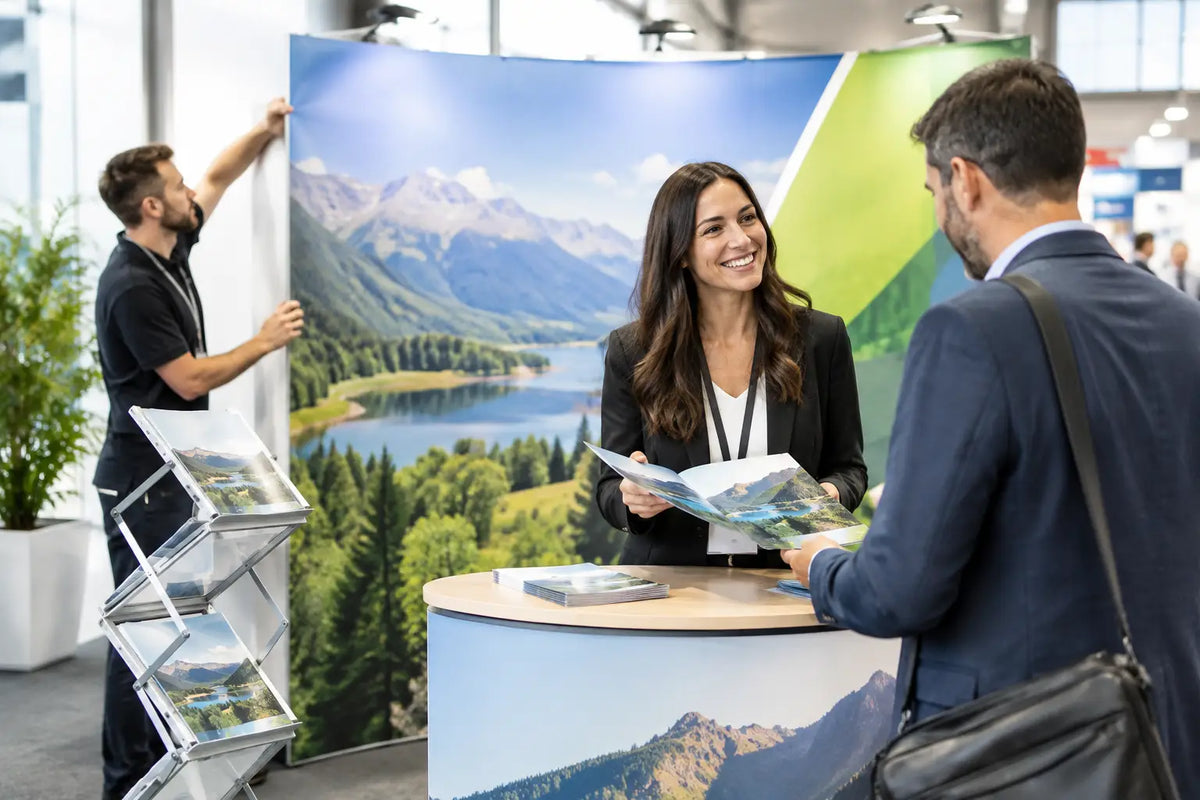
A busy exhibition hall gives visitors seconds to decide where to look. Your trade show backdrops do the work before a conversation begins: they show who you are, what you offer and why someone should stop. Get the backdrop right and even a compact stand can feel established, clear and professional. Get it wrong and a well-prepared team can disappear into the visual noise.
For businesses attending local trade fairs, hospitality showcases, recruitment events or major exhibitions, the aim is not simply to fill the space behind a table. It is to create a branded setting that supports real conversations and gives your staff a confident place to meet prospects.
Start with the job your backdrop needs to do
The best display depends on the event, the available floor space and how often you plan to use it. A one-day networking event in a hotel function room calls for something very different from a three-day show at a large exhibition venue.
Think first about viewing distance. People walking past should recognise your business name and main offer from several metres away. Once they approach, supporting details such as services, credentials or a QR code can help them take the next step. Trying to communicate everything at the same distance is where many designs lose their impact.
Your backdrop should also suit the role of the stand. A retailer launching a new range may need large product imagery. A construction firm might lead with completed projects and accreditations. A professional service business often benefits from a clear proposition, a confident brand image and less clutter. Community groups, schools and charities may need an adaptable display that works for several campaigns across the year.
Choosing trade show backdrops for your space
There is no single best format. Portability, visual impact, durability and budget all matter, and the right balance depends on how you exhibit.
Pop-up display stands
Pop-up systems create a broad branded wall behind your stand and work particularly well when you need a strong presence in a standard shell-scheme space. They are a good choice for businesses that exhibit regularly and want a polished, substantial backdrop without building a custom stand each time.
The trade-off is transport and set-up. While modern systems are designed to be manageable, they take up more room than a pull-up banner and need enough clear space behind or beside your table. Check the event’s stand dimensions before ordering, especially if you are displaying product samples, furniture or literature as well.
Fabric backdrops
Fabric displays offer a smooth, high-end appearance with less glare than some traditional printed surfaces. They are popular for photography, social media content and events with bright indoor lighting. Depending on the system, the fabric can fit over a lightweight frame or attach to a tension structure, creating a clean edge-to-edge branded finish.
They are especially useful where presentation matters, such as wedding fairs, education events, beauty exhibitions and hospitality showcases. Ask about the care requirements, though. Fabric is practical for repeat use, but it should be packed properly and kept clean between events.
Roller banners and modular displays
For smaller pitches, roller banners remain one of the most flexible options. They are quick to carry, quick to assemble and easy to position around a table, demonstration area or entrance. Two or three coordinated banners can create the effect of a larger backdrop while allowing you to adapt to different venues.
This approach works well for tradespeople, start-up businesses and teams attending several smaller events. The limitation is continuity: separate banners need a disciplined design so they read as one display rather than three unrelated adverts. Use the same background colour, typefaces and image style throughout.
Design for a person walking past, not a person reading a leaflet
A backdrop is large-format print, so it needs a different approach from a flyer or brochure. Text that looks sensible on a laptop can become tiny and ineffective when placed high on a display wall.
Lead with your logo, a short message and one visual idea. That might be a striking product image, a photograph of your team at work or a simple graphic that immediately says what you do. For example, “Commercial cleaning for Northern Ireland businesses” is clearer from a distance than a paragraph describing every cleaning service available.
Keep essential information in the central, most visible area. Event furniture, tables and people standing at the front can hide the lower section of the display. Avoid placing your website, phone number or key message close to the floor. Equally, do not put vital small text at the very top, where it may be difficult to read under venue lighting.
Use contrast with purpose. Pale lettering over a busy photograph is difficult to read, even if it looks attractive on screen. A solid colour panel behind text, or a carefully darkened section of the image, will usually perform better. Brand colours should be recognisable, but readability comes first.
Make the message useful
Visitors do not need your full company history while they are walking an exhibition aisle. They need a reason to pause. A direct benefit, a clear sector focus or a timely offer can give them one.
Instead of “Quality products and excellent service”, say what that means for the customer. “Next-day business print in Northern Ireland”, “Bespoke kitchens made in Armagh” or “Free site surveys for commercial security” all give a clearer starting point. Your team can then provide the fuller story in conversation.
Prepare artwork properly before it goes to print
Large-format print reveals problems that can go unnoticed in a small online proof. Low-resolution images can look soft or pixelated, while files created at the wrong size may have to be enlarged beyond their useful quality.
Where possible, create artwork to the supplied template for the exact display system. Templates account for bleed, safe areas and any parts that wrap around a frame or sit within a cassette. A design made for one banner size is not automatically suitable for another.
Use high-resolution photographs and original logo files. Vector formats are ideal for logos, icons and text because they remain sharp at larger sizes. If you only have a small logo pulled from a social media profile, ask for help before committing to print. It is often possible to source a better file or rebuild simple artwork, but it is far better to resolve this early.
Check every detail in the final proof: spellings, telephone numbers, dates, prices and social handles. Have someone unfamiliar with the design read it too. Fresh eyes often catch a missing digit or a message that makes sense internally but not to a first-time visitor.
Plan the whole stand, not just the printed wall
Your backdrop should support the rest of your exhibition materials. Match it with business cards, flyers, brochures, tablecloths, posters or product boards so visitors see one consistent identity. This does not mean every item must carry the same large photograph. It means the logo, colour palette and message should feel connected.
Think about practical sightlines as well. If your stand has a table, place it far enough forward that visitors can step in without blocking your main display. Keep boxes, coats and spare stock out of view. A tidy stand makes a modest display look more considered, while clutter can undermine even premium print.
Lighting can change the result. Gloss finishes may look vibrant under controlled lighting but can reflect spotlights in some venues. Fabric and matt options can reduce glare, although colours may appear slightly softer. If you attend a venue regularly, take note of the lighting and photograph your set-up for future improvements.
Make repeat use part of the buying decision
A trade show backdrop is an investment in more than one event. Before choosing a system, consider where it will be stored, who will carry it and how quickly it can be assembled by the people actually attending the show.
A large display can be worthwhile for a flagship exhibition, but a compact banner system may deliver better value if your team is regularly travelling between schools, community halls, hotel venues and client sites. It depends on how often the format will be used and whether every venue offers the same amount of space.
Keep cases, frames and printed panels together after each event. Wipe down any marks, allow fabric to dry if it has been exposed to damp conditions and store components somewhere dry. A few minutes of care protects the finish and avoids last-minute problems before the next show.
A backdrop should open the conversation
The strongest display does not try to replace your sales team. It earns them the first look, makes the business easy to remember and gives every conversation a professional backdrop. Choose a format that suits your events, keep the message focused and allow enough production time for artwork checks and finishing.
If you need practical support with design, print and display choices, Instant Print NI can help turn an idea into exhibition materials that are ready to set up, pack down and use again with confidence.