
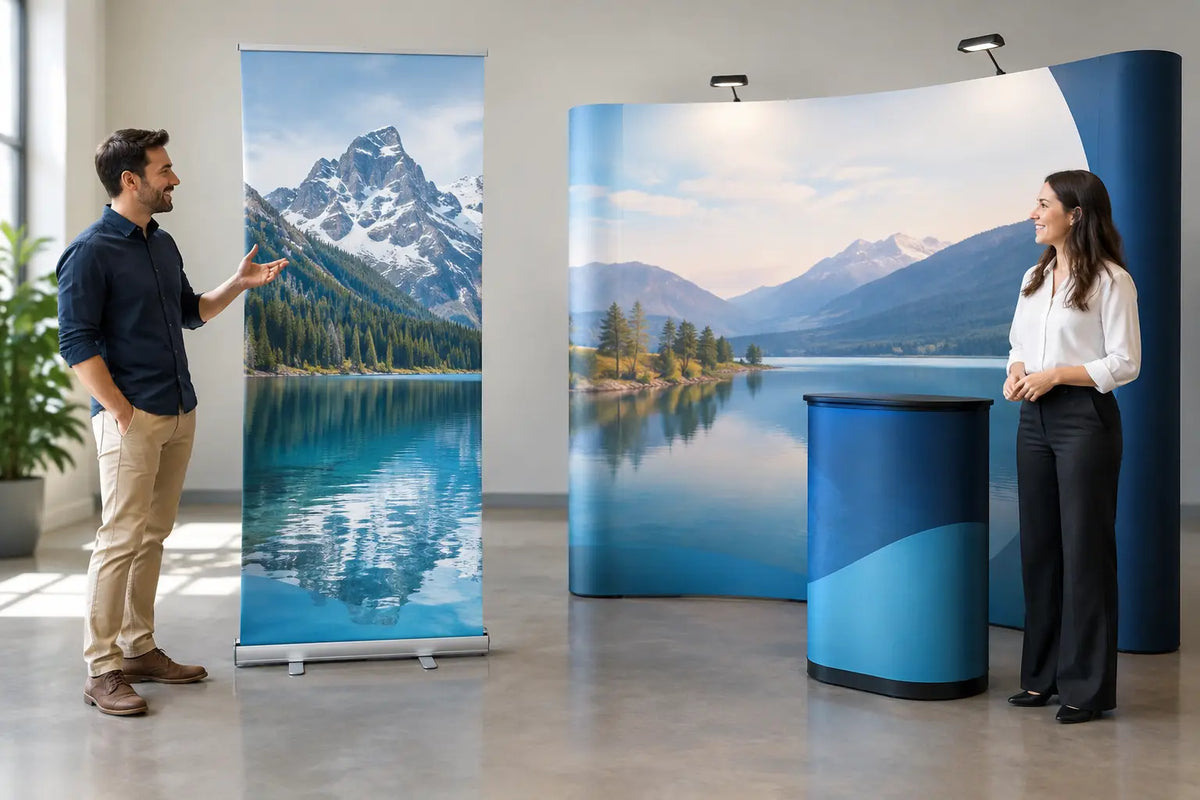
A display stand has a short window to work. Whether it is placed at a trade counter, exhibition hall, school open day or community event, people should understand who you are and what you offer before they walk past. Choosing between pull-up versus pop-up displays affects how easily your message travels, how much space it commands and how often your team will actually use it.
Both formats can make a strong impression with professionally printed graphics. The right choice comes down to the job at hand: a compact, repeat-use banner for busy staff, or a larger branded backdrop designed to be seen across the room.
Pull-up versus pop-up displays: the key difference
A pull-up display, often called a roller banner, stores its printed graphic inside a slim aluminium cassette. To set it up, place the base on the floor, pull the banner upwards and secure it to the support pole. It is one of the quickest ways to create a polished branded presence, particularly when one person is setting up.
A pop-up display is a wider exhibition system. Its lightweight frame expands into shape, usually with magnetic graphic panels or a fitted fabric graphic attached to it. Once assembled, it creates a broad visual wall that can carry large photography, a campaign message or a complete branded setting.
The distinction is not simply small versus large. Pull-up banners are designed for portability and speed. Pop-up stands are designed for impact and a more immersive event space. Both have a place in a practical marketing kit, and many organisations benefit from keeping each for different occasions.
When a pull-up display is the better choice
A pull-up display suits businesses that need to arrive, set up and get on with the day. It is particularly useful for independent retailers running a promotion, tradespeople attending supplier events, service firms at networking breakfasts and schools hosting information evenings. A single banner can be ready in well under a minute, with no tools or specialist knowledge required.
Transport is a major advantage. Most pull-up banners come in a carry case and fit easily into a car, so there is no need to arrange extra space or make several trips from the car park. For teams moving between sites, venues or client meetings, that convenience matters. The stand is also easy to store in an office, stockroom or cupboard between uses.
Pull-up displays are generally the more budget-conscious option, especially if you need several messages in different locations. A café may use one near the entrance to promote seasonal offers, while another highlights recruitment at a local jobs fair. A building contractor might take a safety-focused banner to site meetings and a separate services banner to exhibitions.
Their limitation is visual scale. A standard pull-up banner gives you a tall, narrow canvas, which is excellent for one clear message but less suitable for presenting a broad product range, detailed photographs or a full backdrop. Trying to fit every service, contact detail and social media message onto one banner weakens the result. Keep the main headline large, use a focused image and let the banner start a conversation rather than replace one.
Best uses for pull-up banners
Pull-up displays work especially well at reception areas, retail entrances, presentations, training sessions, small exhibition stands, open days and temporary promotions. They can also sit either side of a table or counter to frame a space without making it feel crowded.
For businesses ordering regularly, it is worth keeping the design evergreen. Include your logo, core service, website or contact method, but avoid dates and short-term offers unless the banner is intended for one campaign only. A well-planned roller banner can work hard for several years.
When a pop-up display earns its space
A pop-up display is built for occasions where your brand needs to look established, visible and fully prepared. Think trade shows, conferences, large recruitment events, hospitality launches, charity fundraisers and exhibition stands where competitors are only a few metres away. The broad format creates a proper backdrop rather than a sign beside a table.
This additional width changes the way people see your stand. It can make a small allocated area feel more purposeful, hiding a plain venue wall and giving staff a clear place to greet visitors. It also provides room for a hero image, a strong brand statement and a supporting message without forcing the design into a narrow vertical layout.
Pop-up systems are particularly effective for organisations that use photographs to sell their work. A wedding venue can show a beautifully dressed room at scale. A construction company can feature completed projects. A tourism provider can use striking local imagery to create a sense of place. For these applications, the backdrop is part of the experience, not just a source of information.
The trade-off is that pop-up displays demand more planning. Although modern systems are designed to be straightforward, assembly takes longer than pulling up a roller banner. Larger cases can be heavier, and the display needs more room in both your vehicle and your storage area. It is wise to have two people available for bigger setups, particularly if you are working to a tight event schedule.
Cost should also be considered in terms of use. A pop-up display may cost more upfront, but it can be worthwhile for a business exhibiting several times a year. If it helps your stand attract more conversations and gives your team a professional space to work from, it is an investment in how your organisation is perceived.
How to choose the right display size
Start with the venue, not the artwork. Ask where the display will stand, how much floor space you have and how far away visitors are likely to be when they first see it. A pull-up banner may be ideal in a narrow reception area, but it can disappear in a large exhibition hall. A wide pop-up display may look impressive at a conference, yet overwhelm a small shop floor.
Consider what will sit around it too. If you have a branded tablecloth, product samples, leaflets and staff on a compact stand, a pop-up backdrop can pull everything together. If your display will stand alone in a corridor or beside a point of sale, a pull-up banner often gives the clearest result with the least fuss.
Viewing distance should guide your text size. A headline needs to be readable from several metres away, while supporting details can be viewed closer up. QR codes, phone numbers and calls to action should be large enough to use comfortably, but they should not compete with the main message.
Design matters as much as the stand
The strongest display graphics do not try to say everything. They answer three questions quickly: who are you, what do you offer and what should the viewer do next? For a pull-up display, this may mean a bold service statement, one strong image and clear contact details. For a pop-up display, you have more room to develop a campaign or showcase a range of work, but the same discipline applies.
Use high-resolution images and artwork prepared to the correct template. Images that look acceptable on a phone screen can become soft or pixelated at large format. Logos should be supplied in suitable quality, and any important wording should stay clear of trim areas, panel joins and the lower section of a banner where it may be less noticeable.
Colour consistency is another reason to use a professional print supplier. Your display materials should sit comfortably alongside business cards, flyers, signage and branded merchandise. If your blue looks different on every item, the overall impression becomes less considered.
At Instant Print NI, the team can help turn an existing logo, campaign artwork or initial idea into display graphics that are practical to produce and clear at event scale. That hands-on support is useful when deadlines are tight or artwork files are not quite ready for print.
Buying for one event or building a reusable kit
If you have one exhibition booked, it can be tempting to choose the cheapest available option and worry about future events later. A better approach is to think about how your display will be used over the next year. Will staff travel to several events? Will the message remain relevant? Do you need a backdrop for photographs, presentations or social posts?
For frequent local events, a pull-up display is often the dependable workhorse. It is easy to collect, transport and reuse, even when the person setting it up has never handled it before. For major annual exhibitions, a pop-up display can become the centrepiece of your stand, supported by matching banners, leaflets and table displays.
Some organisations choose a combined setup: a pop-up backdrop for the main exhibition space and one or two pull-up banners for directions, offers or key services. This gives the stand depth without asking one graphic to do every job. It also means the roller banners can continue to earn their keep at smaller events throughout the year.
Before ordering, measure your available space, confirm venue rules and plan how the display will travel. Then choose the format that makes it easy for your team to show up looking prepared. The best stand is not necessarily the largest one - it is the one that carries your message clearly, arrives on time and gets used whenever an opportunity comes along.