
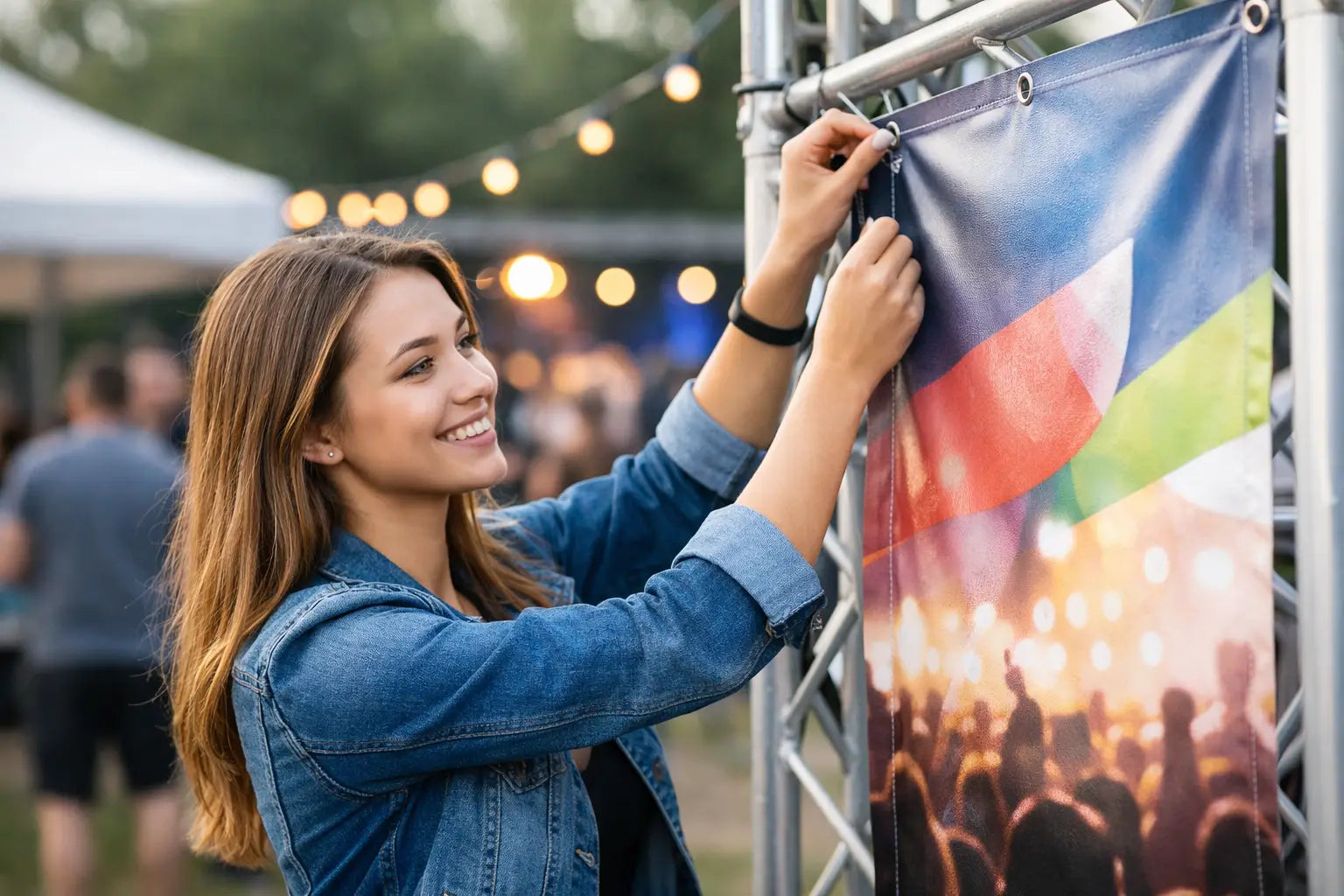
A busy event site gives people only seconds to work out where to go, what is happening and who is behind it. PVC banners for events put that information where it needs to be - at an entrance, beside a stage, along a barrier or outside a venue - in a format built to be seen from a distance.
For a school fete, trade stand, charity run, hospitality launch or community festival, a banner is often doing several jobs at once. It welcomes visitors, directs footfall, promotes sponsors and gives the event a more organised, professional feel. The best result is not simply a large logo. It is a clear message, in the right size, printed on a material suited to where and how it will be used.
Start with the job your banner needs to do
Before choosing a size or sending artwork, decide what success looks like. A banner above a registration desk should make the check-in point obvious. A banner fixed to railings may need to advertise a headline sponsor. One at a roadside entrance needs a short message that can be read by passing traffic.
This changes the design. An event name and date can work well close up, but a banner viewed from across a car park needs fewer words and much larger lettering. If visitors must act on the message, such as following an arrow to parking or scanning a QR code, give that instruction priority rather than squeezing in every detail from the event programme.
It also helps to think about the full visitor journey. One well-placed banner at the gate is useful, but a coordinated set of signs from arrival through to the main activity area prevents confusion and makes the event feel considered. This is particularly valuable for multi-room conferences, open days and outdoor events spread across a larger site.
Choosing PVC banners for events by location
PVC is a practical choice because it is durable, weather-resistant and suitable for bold, full-colour print. However, the right specification depends on the location. Indoor banners may need a neat, clean presentation for a reception area or exhibition space. Outdoor banners need secure fixing points and a layout that remains legible in changing light and weather.
Outdoor entrances, railings and fences
For outdoor use, standard PVC banner material is a dependable option for temporary promotions, seasonal events and recurring fixtures. Eyelets around the edge make it straightforward to attach the banner with cable ties, bungee cords or rope. Keep the banner pulled taut, but do not over-tighten it to the point where the eyelets or material are placed under unnecessary strain.
Wind is the main consideration. A banner fixed to an exposed fence catches far more pressure than one against a solid wall. In very windy locations, mesh banner material can be a better choice because it allows air to pass through. It is not always needed, and it can slightly soften small details, so it is most suitable for bold logos, large type and simple graphics rather than fine print.
Allow space around the design too. Text placed too close to the edge can be obscured by eyelets, folds or fixings. A sensible safe area gives your message room to breathe and protects important details during finishing.
Indoor displays and stage areas
At indoor events, PVC banners work well behind registration desks, on feature walls, at photo areas and around stages. Here, viewing distance matters more than weather resistance. A wider horizontal banner is often effective for a sponsor backdrop or stage header, while a tall format can help draw attention to a specific stand or entrance.
Check the venue rules before ordering. Some locations have restrictions on how displays can be fixed, whether freestanding hardware is required, or where signage may be placed. Knowing this early avoids arriving with a banner that is the right print size but cannot be installed safely.
Reusable event signage
If you run regular markets, sports fixtures, networking events or fundraising days, reusability should shape the design. Avoid including a single date if the banner will be needed again next month or next year. A general message such as “Welcome to our Community Market” will usually deliver better value over time than a banner tied to one occasion.
Store reusable banners rolled rather than folded, in a dry, clean space. This helps reduce creases and keeps the print ready for the next event. Label each roll clearly if you have several banners for different zones, sponsors or campaigns.
Get the size and reading distance right
Bigger is not automatically better. A banner must fit its available space, be practical to transport and suit the distance from which people will see it. A compact banner can be ideal at a table or inside a small venue, while a large frontage or playing field may need a much wider format to make an impact.
As a working rule, the further away the viewer, the less copy you should use. At a distance, people will recognise a strong logo, a headline and a simple direction long before they can read a paragraph. Put the main message in the largest type, then support it with only the details visitors need immediately.
For example, a food festival entrance could lead with the event name and an arrow for admission. A recruitment fair banner might lead with “Meet Local Employers” followed by the date, venue and a simple call to action. A charity event could give the cause pride of place, with sponsor logos arranged along the bottom rather than competing with the headline.
Design for a fast decision, not a close inspection
Event banners are not brochures. Their job is to communicate quickly in a visually busy environment. Strong contrast is usually more valuable than a complex background image. Dark lettering on a pale background, or pale lettering on a dark background, is easier to read than colours of similar tone.
Keep logo files sharp by supplying vector artwork where possible, such as a print-ready PDF, AI or EPS file. For photographs and raster graphics, high resolution is essential at the final print size. A small image lifted from social media may look acceptable on a phone but can appear soft and pixelated on a large banner.
If your team is producing the artwork, build it at the correct dimensions and include bleed where requested. Do not rely on a thin border sitting exactly at the edge, as slight movement during trimming and finishing can make it look uneven. If you are unsure about file setup, getting an artwork check before production is a far better use of time than discovering an issue on event morning.
Plan installation before the banner arrives
A printed banner only works if it can be fitted safely and visibly. Measure the actual fixing area, including posts, railings and any gaps around doors or windows. It is common for an organiser to order a banner based on a rough estimate, then find that it overlaps an entrance or has nowhere suitable to secure the corners.
Think about what you will need on site: cable ties for railings, bungees for temporary tension, rope for suitable frames and scissors or cutters for trimming ties. Use enough fixing points to distribute the weight and reduce flapping. For long banners, fixing only the four corners is rarely enough outdoors.
If the event has public access, do not create trip hazards with loose rope or place banners where they block emergency signage, sightlines or access routes. A little planning protects the banner, the venue and your visitors.
Timing matters as much as the print
Event deadlines are rarely flexible. A banner may be the last item required before doors open, especially when sponsors, schedules or venue details are confirmed late. That is why artwork approval, finishing requirements and delivery dates should be agreed as early as possible.
Leave time for a proofing check. Read every date, postcode, telephone number and sponsor name aloud before approving artwork. Ask someone who has not worked on the design to check it too. Fresh eyes often catch a missing digit or an outdated logo that the original designer has stopped seeing.
For organisers across Northern Ireland, Instant Print NI can provide in-house support from artwork through to production and delivery, including fast turnaround options where the deadline is tight. The earlier the conversation starts, the more choice you retain over material, size and finishing.
A well-made banner should make the day easier for everyone: visitors know where to go, sponsors receive visible value and your event looks ready before the first guest arrives. Choose a clear message, match the material to the location and make installation part of the plan - then your display will work hard from setup to pack-down.